
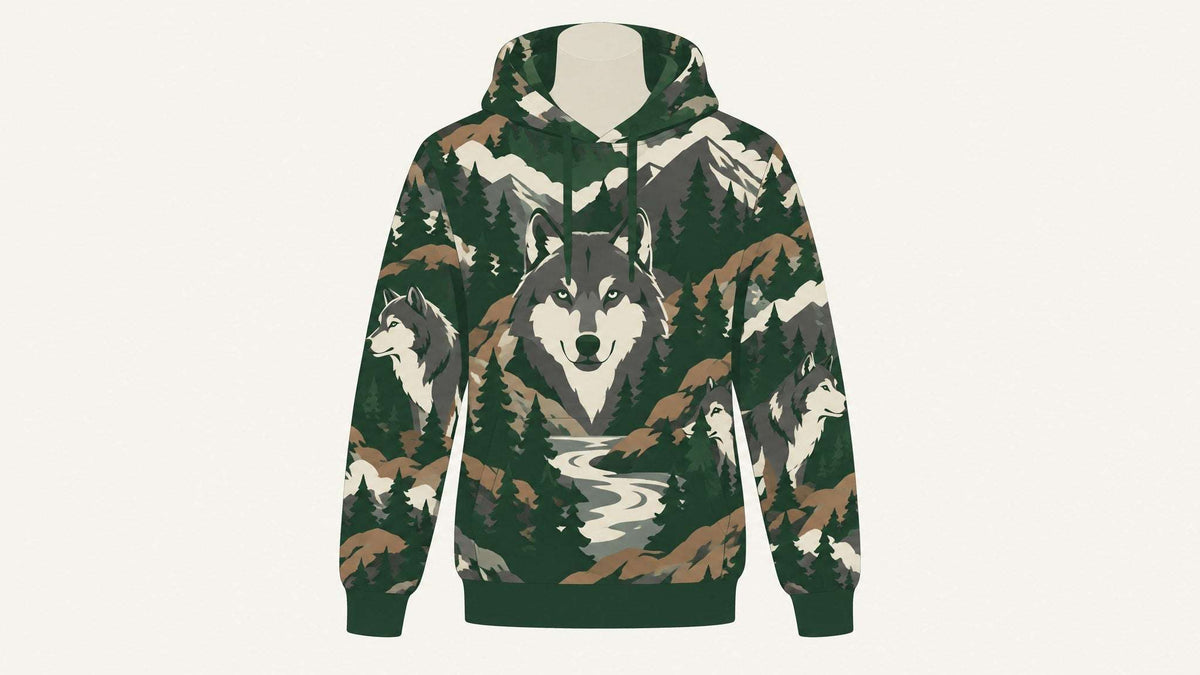
All Over Print Vs Regular Print Hoodie: Which Stands Out?
Your wardrobe is a broadcast signal. The print style you pick decides the frequency. A standard front print sends a clear, focused message to anyone standing right in front of you. All-over coverage turns your whole silhouette into something that refuses to be ignored from any angle. Understanding the difference between all over print vs regular print hoodie styles isn't just about looks. It's about deciding how loudly you want your identity to speak before you say a word.
We make stuff for people who stand out, so we know picking between these two formats takes more than liking a graphic. You need to know how the ink sits on the fabric, how the design ages through years of wear, and which format actually fits the vibe you're building. This guide breaks down the technical and stylistic realities so you stop guessing and start wearing pieces that match your energy.
Visual Impact: Edge-to-Edge Coverage vs Centered Graphics
The real difference in any statement hoodie comparison is how the design sits on your body. A standard front print treats the garment as a backdrop for one piece of art, with the base fabric color framing the image. All-over printing drops the boundaries and turns the whole textile into a canvas.
Why All-Over Print Demands Attention
You can't accidentally blend in when your clothing has no negative space to hide behind. The Wolf All Over Print Cotton Hoodie shows this with edge-to-edge coverage: the forest wolf design runs continuously across sleeves and body, so you take in the whole composition instead of scanning past a chest logo. It respects the three-dimensional shape of the wearer instead of treating the hoodie as a flat billboard.
Edge-to-edge coverage moves in a way a static center print never will. When you move, the pattern shifts with your body, making the art feel alive rather than stamped on. That's why all-over print hoodies dominate in subcultures where visibility matters, the garment doesn't just display an image, it becomes one.
When a Front Print Says Enough
Not every outfit needs to shout. Sometimes a centered graphic sends exactly the right amount of signal without taking over your whole presence. Regular prints work well when the hoodie is part of a layered outfit, with jackets, chains, or pants also competing for attention. A contained front or chest print leaves breathing room that maximalist designs give up on purpose.
This format also suits certain artistic choices better than full coverage. High-contrast typography, minimalist icons, or single illustrations often lose punch when stretched across seams and folds, so keeping them centered protects their intended impact. You pick this style when the message matters more than the medium, the graphic becomes a deliberate accent, not an environment.
Fabric Feel and All Over Print Hoodie Quality
Comfort decides whether a bold piece stays in rotation or dies at the back of the closet after one wear. Plenty of people assume covering every inch of fabric with ink creates a heavy, plastic-like shell. Modern direct-to-fabric techniques have rewritten what all over print hoodie quality actually feels like against skin.
Direct-to-Fabric Softness in AOP
Tenino Ventures uses direct-to-fabric printing on its AOP cotton hoodies, so the design becomes part of the textile instead of a surface layer that cracks or peels. The ink bonds with the cotton fibers rather than sitting on top as a separate film, so the fabric keeps its natural drape and breathability. You get the visual intensity of full coverage without giving up the tactile comfort that makes a hoodie worth wearing daily.
The Chibi Food Festival Hoodie wraps bright, joyful colors around the entire garment, front, back, and sleeves, to build an immersive kawaii anime scene while staying soft throughout. Because the pigment soaks into the fiber instead of coating it, the fabric keeps regulating temperature and wicking moisture even under dense color saturation. That's what separates premium AOP from cheap novelty gear that feels like wearing a vinyl banner.
Texture Differences You Can Feel
Run your hand across a traditional screen-printed graphic and you'll feel a ridge where the ink sits above the weave. That raised texture is the mark of surface-level application. It's fine for a small logo, but it turns uncomfortable and stiff once scaled up to cover large areas, and your skin notices the friction fast, especially during extended wear or activity.
Direct-to-fabric printing removes that ridge entirely, so the print feels indistinguishable from the cloth. The hand-feel stays consistent from hem to cuff, which matters a lot when you're committing to a garment that covers your whole torso and arms. If sensory comfort drives your buying decisions, this texture is the one thing to check first.
Durability and Wash Care: Fading, Cracking, and Longevity
Bold graphics mean nothing if they fall apart after a few laundry cycles, so it's worth understanding how each format ages. Which hoodie print style lasts longer depends on the bonding method, and the answer differs a lot between traditional surface applications and modern sublimation techniques.
Sublimation vs Screen Print Aging
Thick plastisol inks used in many regular prints crack easily because they flex independently from the fabric underneath. Every time you move or wash the garment, stress builds at the boundary between ink and fiber until it fractures and the design breaks down. This isn't a manufacturing defect. It's built into the layering process, and it speeds up with larger print areas.
Sublimated all-over prints skip this problem because there's no separate layer to fail. The dye lives inside the fiber, so it stretches, compresses, and recovers exactly as the cotton does. Expect vibrant color and structural integrity through hundreds of washes, because the print ages at the same rate as the garment rather than failing early.
Washing Bold Graphics Without Fear
You should still treat printed apparel with basic care, but AOP removes the anxiety that comes with fragile surface graphics. Turn garments inside out and wash in cold water to protect the print and the fabric from needless wear. You won't face the catastrophic cracking that comes with aged screen prints. The Cat Cafe Hoodie keeps its pastel palette and detailed line work through regular laundering because the color is locked into the cotton rather than sitting on top of it.
Skip high-heat drying when you can, to keep colors from dulling over years of use. The bond itself is permanent, but thermal stress can still fade any dyed textile over time, and protecting that investment takes almost no effort. The payoff: a piece that looks as sharp in year three as it did on day one, while conventional prints start declining almost right away.
Styling Statement Pieces: Who Should Wear What
Choosing between all over print vs regular print hoodie formats is really an identity decision wearing a fashion choice's clothes. Neither option beats the other across the board. Each serves a different relationship between wearer, garment, and audience, so matching the format to what you're trying to say matters more than chasing trends.
Maximalist AOP for Identity-Driven Wardrobes
If your clothing is primary self-expression and not background utility, all-over print is your native language. These pieces anchor an entire outfit and communicate your aesthetic instantly, a good fit for anyone whose style draws from niche subcultures, surrealism, or bold visual narratives. The Storm Raven All-Over Print Cotton Sweatshirt blends gothic energy with cinematic detail across the full garment, a statement piece that demands engagement instead of a passing glance.
You wear AOP when you want the garment to do the talking. It pairs naturally with weirdcore fashion aesthetics and other visually dense styles where restraint reads as fake. For anime hoodies for streetwear, full coverage honors the source material's world-building in a way a cropped center print never could.
Versatile Regular Prints for Layering
Standard placement prints suit people who treat individual garments as components rather than centerpieces. They slide easily under denim jackets, leather coats, or vests without creating visual chaos, which gives you room to adjust your statement depending on context. That's what makes them foundational for wardrobes built around range over one big impact.
Regular prints also give you a quieter way into bold aesthetics if you're still testing the waters. You can signal affiliation without full commitment, using the graphic as an accent that complements rather than takes over. If you're weighing garment types beyond print style alone, our sweatshirt vs regular hoodie comparison breaks down how silhouette and print placement work together.
Design Complexity: Seamless Patterns vs Discrete Artwork
Technical limits shape what each format can do, and each excels at a different kind of visual storytelling. Knowing these strengths helps you judge whether a design concept will actually translate to fabric or fight the medium.
All-over printing unlocks continuous patterns, gradients, and full scenes that would fall apart on a bounded print area. The Retro Pinup Hawaiian Shirt leans on AOP to keep its story flowing across seams, wrapping tiki culture and vintage surf imagery around the wearer as one unbroken scene. That's impossible with discrete placement, where artwork has to stop at an arbitrary edge and the composition breaks into fragments.
Regular prints favor high-contrast, self-contained artwork that reads clearly within its own borders. Typography, logos, and standalone illustrations gain focus from negative space instead of losing it to competing visual noise. Stretch that kind of design across an entire garment and it often loses its punch, more coverage doesn't automatically mean a better design.
Price and Value: Investing in Bold Apparel
All-over print hoodies usually cost more than standard front prints, since they use more fabric, need specialized equipment, and come off the line slower. You're paying for complexity and exclusivity, not bulk efficiency, print-on-demand makes each piece individually instead of spreading costs across thousands of identical units. Our print on demand clothing cost breakdown walks through the economics behind that pricing.
The value here comes from being one-of-a-kind, not from mass availability. According to iEDM's analysis of all-over print value, shoppers can save up to 45% site-wide on bold apparel if they time it right. The real return is owning something made because you wanted it, not because a factory needed to clear inventory.
AOP doesn't suit everyone, and pretending otherwise isn't honest. If you prefer subtlety, need maximum layering flexibility, or want the lowest entry price, regular prints serve you better than forcing yourself into a format that fights your actual preferences. Authenticity means picking what fits your life, not performing boldness for its own sake.
Choosing Your Next Hoodie Based on Personality, Not Trends
The best hoodie print style is whichever one matches how you actually want to move through the world. If you want to be seen, the immersive canvas of all-over coverage delivers. If you build outfits through layering and small shifts, regular prints give you the flexibility you need. Both formats deliver when matched to what you actually want; neither fails except through the wrong match.
Browse the all-over print hoodie collection to see these ideas on actual garments, made for people who refuse to disappear. Trust your own read on what resonates instead of defaulting to the safe or trending choice. Your clothing should amplify who you already are, not costume you as someone else.
Frequently Asked Questions
What type of print is best for hoodies?
The best print type depends entirely on your styling goals and comfort preferences. All-over sublimation printing offers superior durability and softness for bold, immersive designs, while traditional screen printing works better for focused graphics that need negative space for visual impact. Choose based on whether you want the garment to be the statement or part of a layered ensemble.
Which print lasts longer after washing?
All-over sublimation prints last significantly longer because the dye bonds with fabric fibers rather than sitting on top as a separate layer. Screen prints crack and peel over time as the ink film degrades independently from the textile, especially with frequent washing. Sublimated designs age at the same rate as the garment itself, maintaining integrity through hundreds of wash cycles.
What does all-over print mean?
All-over print means the design covers the entire garment surface including front, back, sleeves, and often the hood without interruption or blank spaces. The artwork is printed directly onto the fabric before cutting and sewing, creating seamless coverage that transforms the textile into a continuous canvas. This differs from regular prints that apply graphics only to specific zones like the chest or back.
Are all-over print hoodies worth the higher price?
Yes, if you value durability, comfort, and exclusive design over low cost and mass availability. The higher price reflects specialized printing processes, greater fabric usage, and print-on-demand production that creates each piece individually rather than in bulk. You're investing in a garment that won't crack, feels soft against skin, and exists because you ordered it specifically.

Leave a comment
This site is protected by hCaptcha and the hCaptcha Privacy Policy and Terms of Service apply.