
Hawaiian Shirts Fashion Guide: Styling Tips and History
Hawaiian shirts don't belong to any one type of person, and that's exactly the point. The boldest version of this garment has always been a refusal: to dress like everyone else, to play it safe, to disappear into a sea of grey. Whether you're building a streetwear look from scratch or just done settling for forgettable clothes, Hawaiian shirts are one of the few pieces that carry genuine visual power. This guide covers history, styling, fit, fabric, and how to find one that actually reflects who you are.
What Makes a Hawaiian Shirt Actually Work
The anatomy of a great Hawaiian shirt
The line between a statement and a costume is thinner than people think. What makes a Hawaiian shirt land is intention, the print, the cut, and the fabric all have to work together.
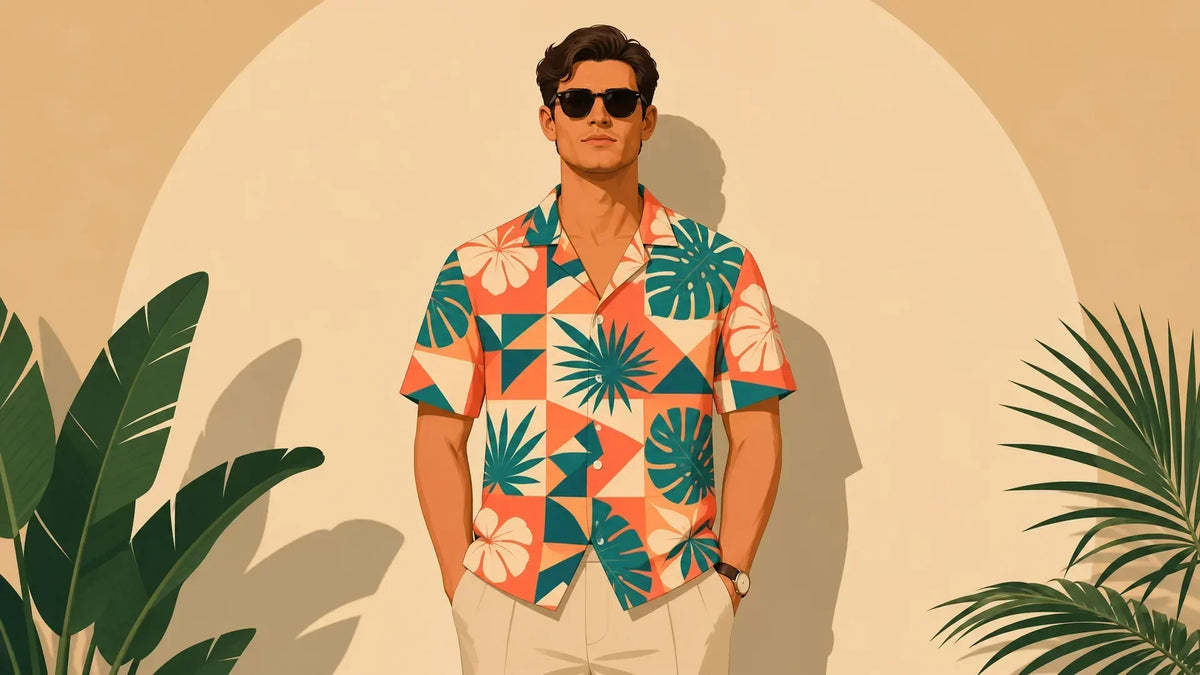
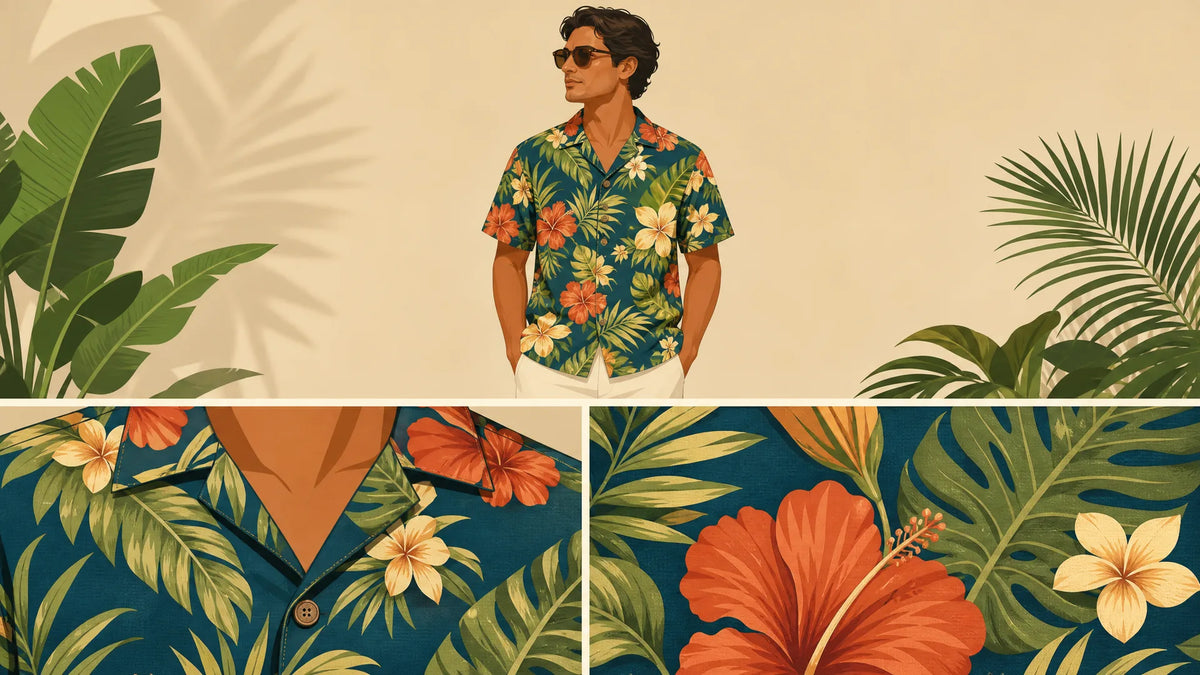
A great shirt has a print with clear design logic: motifs that repeat with purpose, colors that don't muddy each other, and enough contrast to read from across the room. Busy doesn't mean good. A chaotic print with clashing hues looks cheap regardless of price. A confident, graphic print, even a maximalist one, has internal order that makes it feel designed rather than thrown together.
Collar type matters. The traditional camp collar (open, wide, folded flat) is the authentic choice and the most versatile. Revera and Cuban collars work in the same visual space. Avoid shirts that dress up a Hawaiian print with a stiff button-down collar, it fights the garment's whole energy.
Fabric, fit, and print quality
Rayon (viscose) is the benchmark fabric for Hawaiian shirts. It drapes beautifully, holds color saturation better than most synthetics, and breathes well in heat, which is why it's been the go-to for authentic Aloha shirts since the beginning. Cotton is a solid alternative for a more structured feel. Polyester is common in cheaper mass-market versions and tends to trap heat, though modern print-on-demand fabric and durability improvements have closed the gap significantly.
Fit: most people size up one from their usual. Hawaiian shirts are meant to have some ease, not boxy, but not stretched across the shoulders either. The chest should fall cleanly, the hem should sit at the hip, and the print should have room to breathe. A shirt pulled tight across the back loses its graphic impact.
Print quality is where all-over print construction earns its keep. Traditional cut-and-sew Hawaiian shirts repeat a pattern panel by panel. All-over print design techniques push color and pattern edge-to-edge across the entire garment, no interruptions, no faded seams, full graphic intensity from collar to hem.
A Brief History of Hawaiian Shirts (And Why They Never Really Left)
The Hawaiian shirt, known in the islands as the Aloha shirt, dates to the 1930s, when Japanese immigrants in Hawaii began sewing bright, tropical-print garments from kimono fabric. Local tailors adapted bold patterns for the warm climate, and the shirts spread fast. By the 1950s they were a leisure-wear staple worn by everyone from beach tourists to U.S. presidents on vacation.
The surf culture of the 1960s pushed them further into the mainstream, cementing their association with freedom, warmth, and deliberate informality. The 1970s and 80s turned them into a tourist shorthand, the souvenir shirt, the dad shirt, the retiree uniform. That era calcified a stereotype the shirt has spent decades fighting off.
It keeps winning. Every decade brings a reinvention: the camp-collar revival of the 1990s, the vintage Aloha collecting boom of the 2000s, the streetwear and luxury crossover of the 2010s. By the mid-2020s, designers like Versace and Prada had sent bold botanical all-over shirts down the runway, and by 2026 the Hawaiian shirt is a serious fashion item, not resort kitsch.
The throughline isn't trend cycles, it's the people who wear them. The Hawaiian shirt has always attracted people who refuse to dress like everyone else. Surfers, musicians, artists, collectors, subculture kids. That's not nostalgia. That's a lineage.
How to Style Hawaiian Shirts Without Looking Like You're on Vacation
Casual everyday looks
The single most useful styling move: treat the Hawaiian shirt like a layer, not a costume. Wear it open over statement graphic tees and the shirt becomes a jacket, you get the print impact without committing to full "tropical event" energy.
Tucked vs. untucked depends on the bottom, not the occasion. Untucked with slim chinos or raw-hem denim reads casual-sharp. A half-tuck with high-waisted trousers works for a more fashion-forward silhouette. Full tuck into tailored trousers is the move for anyone pushing the shirt into smart-casual territory.
The key is contrast: pair a maximalist top with the simplest possible bottom, plain chinos, raw-hem denim, or solid shorts, so the shirt does all the talking. A Hawaiian shirt competing with patterned trousers is a fight nobody wins.
Footwear: clean sneakers, loafers, or boots all work. Sandals work too, but they lock in the vacation read. If you want the shirt to feel like streetwear, keep the shoes grounded.
Layering Hawaiian shirts for a streetwear edge
Layering is where Hawaiian shirts move from summer-only to year-round. An open Hawaiian shirt over a hoodie or crewneck sweatshirt breaks the "beach" association completely, the print reads as a graphic element rather than a climate statement. For more on layering bold prints without clashing, the principle is the same: one print leads, everything else supports.
For bold streetwear aesthetics, an oversized Hawaiian worn open over a fitted long-sleeve tee with wide-leg pants is a complete look. The Hawaiian shirt acts as the statement outerwear. No jacket needed.
Hawaiian Shirts for Every Personality, Not Just One Vibe
The dad-on-vacation stereotype stuck because that was the most visible version for a long time. It was never the only version.
Print aesthetics map to real subculture identities. Tropical maximalism, dense florals, parrots, hibiscus, everything saturated, belongs to the unapologetically bold. Dark botanicals (black or navy base, rich jewel-toned prints) pull the shirt into gothic and alternative territory. Retro camp prints, tiki bars, vintage Americana, mid-century illustration, speak to collectors and nostalgia heads. Abstract or graphic all-over prints sit squarely in contemporary streetwear.
This is really about using clothing as identity, the shirt you pick says something specific about where you sit in the culture. That's not overthinking a shirt purchase. That's exactly what clothes are for.
The same garment construction works across all of these aesthetics because the silhouette is neutral. The print carries the identity signal. Which means the print choice matters more than almost any other variable.
Choosing the Right Hawaiian Shirt: Print, Fabric, and Occasion
Fabric first. Rayon for the most authentic drape and color depth. Cotton for structure and a matte finish that reads more casual-everyday. Polyester blends for durability and washability, important if you're wearing this regularly, not just to themed events.
Print type. Panel prints repeat the motif in sections across the shirt, this is the traditional construction and works well for classic tropical aesthetics. All-over prints cover the entire garment continuously, with no visible seam breaks in the pattern. All-over construction raises the visual intensity significantly and is better suited to graphic, abstract, or photographic designs.
Button style. Coconut shell buttons are the traditional choice and signal quality. Plain plastic buttons are fine. Avoid contrasting buttons on a bold print, they distract.
Collar. Camp collar, full stop for most uses. Cuban collar for a slightly more fashion-forward cut. Avoid anything structured.
Sizing. Size up at least one. Two, if you want a more relaxed streetwear silhouette. The fit should be easy through the body, not fitted.
Print-on-demand changes the equation meaningfully. Mass-market Hawaiian shirts pull from a limited library of generic prints. Print-on-demand means a design doesn't have to stop at the chest pocket, pattern, placement, and color saturation can be controlled across the entire garment, giving each piece a graphic intensity that off-the-shelf resort wear can't match. If you want a shirt that actually reflects your personality rather than a stock tropical pattern, that's the path.
Hawaiian Shirts as a Gift, Bold, Memorable, Actually Useful
A Hawaiian shirt is the rare gift that's both immediately wearable and genuinely expressive. It's not a candle. It's not a generic gift card. It's a piece of clothing with a point of view, which means it tells the recipient something about how you see them.
The key is reading the person. Someone who wears bold color already will wear a maximalist floral print immediately. Someone in the alternative or dark-aesthetic space might actually love a deep-base botanical Hawaiian shirt they'd never buy themselves. Graphic and all-over print options let you get even more specific, a shirt built around imagery or aesthetics you know they're into.
Compared to most apparel gifts, Hawaiian shirts are easy on fit (sizing up lands correctly most of the time) and hard to get wrong visually if you know the person's aesthetic. If you're looking for gifts that actually have personality, a well-chosen Hawaiian shirt does what a generic gift never can: it shows you paid attention.
The Hawaiian shirt has survived every decade that tried to make it a joke, because the people who wear them were never in on the joke to begin with. If you want bold graphic apparel built for people who refuse to blend in, explore Tenino Ventures' all-over print Hawaiian shirts and statement apparel, designed for the ones who dress with intention.

Leave a comment
This site is protected by hCaptcha and the hCaptcha Privacy Policy and Terms of Service apply.