

Custom Yoga Mat Print on Demand Business in 2026 | Step-by-Step Guide
Want to sell yoga mats without buying inventory? You can start a custom yoga mat print on demand shop with almost no money up front. In this guide you’ll see how to pick a niche, find a supplier, design mats that sell, set up a store, price for profit, and scale the business.
Grab a notebook. Follow each step. By the end you’ll have a clear plan you can put into action today.
Step 1: Validate Your Niche and Define Your Brand
Before you spend time on a design, you need to know who you’re selling to. A clear niche helps you speak the language your customers use and makes marketing easier.
Start by asking yourself: What group of people cares about yoga mats the most? Moms who practice at home? Teachers who run yoga breaks in classrooms? Nurses who need a quick stretch between shifts? Write down the top three groups that feel the most personal to you.
Next, research the size of each group. The Printful blog notes that fitness‑related niches, such as yoga, are among the most popular print‑on‑demand categories in 2026. It also says you should look for a niche that has high demand, good profit potential, and low competition.
Here’s a quick way to test demand:
- Search Instagram hashtags like #momyoga or #nurseyoga and count the posts.
- Check Etsy for existing yoga mat listings and note how many reviews top sellers have.
- Run a simple poll on a Facebook group asking members what they’d love on a mat.
If you see at least a few hundred engaged users, the niche is worth pursuing.
Now define your brand voice. Are you playful and witty? Or calm and zen? Your tone should match the audience you picked. For example, a brand for teachers could use school‑yard humor, while a brand for nurses might focus on quick stress relief.
Write a one‑sentence brand promise. Something like, “We give busy caregivers a moment of calm on a mat that feels like home.” This promise will guide every design and marketing message.
Finally, sketch a simple brand checklist:
| Checklist Item | Done? |
|---|---|
| Identify target audience | — |
| Validate demand with social listening | — |
| Write brand promise | — |
| Choose brand tone | — |
Use this list to keep your niche and brand sharp before you move to the next step.
For more ideas on niche selection, see the Printful guide on print‑on‑demand niches.
Another useful resource is the same Printful blog, which breaks down why high‑demand niches lead to faster sales.
Step 2: Choose a Reliable Print‑On‑Demand Supplier
The right supplier makes the difference between a mat that looks great and one that peels after a few washes.
First, list the features you need: full‑color printing, eco‑friendly material options, fast shipping, and integration with your store platform.
Mia Merchandise offers a smooth design interface and a range of sizes and materials. It also handles printing and shipping, so you can focus on promotion.
Redbubble gives you global reach and a built‑in community of buyers. That can help you get sales faster if you’re just starting.
Zazzle lets you set your own price and earn a royalty on each sale. This flexibility can boost profit if you have a strong brand story.
When you compare suppliers, look at these criteria:
- Print quality , check sample photos and read reviews.
- Material options , PVC, TPE, natural rubber, or jute each have pros and cons.
- Shipping speed , faster shipping means happier customers.
- Customer support , quick answers save you time.
Order a sample mat from at least two suppliers. Lay it flat, check color vibrancy, feel the grip, and test the durability by rolling it up a few times.
Use the sample test as a checklist. If a supplier fails any key point, keep looking.
For an eco‑friendly perspective, read Yoga Journal’s guide on sustainable mats.
Another useful source is the Mia Merchandise blog, which details how their platform works for yoga mats.

Once you pick the supplier that matches your needs, connect it to your store and you’re ready for design.
Step 3: Create Designs That Stand Out
Great designs are the heart of any custom yoga mat print on demand shop. They need to catch the eye and feel right when you roll out the mat.
Start with inspiration. Look at nature, abstract art, or even the patterns in a favorite yoga studio. Keep the design simple enough to print well on a mat’s surface.
Next, pick a design tool. Canva offers drag‑and‑drop templates made for yoga mats, while Adobe Illustrator gives you full control if you’re comfortable with vectors.
When you upload your artwork, make sure the file is at least 300 dpi and uses the RGB color mode. This ensures the colors stay bright after printing.
Here’s a step‑by‑step workflow:
- Sketch a few ideas on paper. Aim for 3‑5 concepts.
- Choose the strongest sketch and recreate it digitally.
- Apply your brand colors and any text you want. Use short, uplifting words.
- Export the file as a PNG with a transparent background.
- Upload to your supplier’s mockup tool and preview the full‑size mat.
Test the design by printing a single sample. Roll the mat out on a hardwood floor and see if the pattern lines up and the colors pop.
Don’t forget to think about the audience you defined in Step 1. A mom‑focused design might feature playful animal silhouettes, while a nurse‑focused design could use calming blues and a subtle heartbeat line.
Remember, you can always tweak a design after seeing a sample. Small changes like adjusting line thickness can make a big difference.
For more tips on niche‑focused design, see the Printful blog on print‑on‑demand niches.
Another quick read is the same Printful article, which explains how niche research helps shape design choices.
After you lock in a design that you love, move on to setting up your online store.
Step 4: Set Up Your Online Store and Integrate POD
Your store is where customers discover and buy your custom yoga mat print on demand creations. Pick a platform that syncs easily with your supplier.
Shopify is a solid choice because it works with Printify, which offers a free product creator and a catalog of yoga mats.
Start by creating a free Printify account. Once you’re in, find the yoga mat product under the Sports & Games category. Compare the material options, thickness, and price per unit.
Next, add the product to your Shopify store. Use the Printify app to push the product data, images, and pricing automatically.
Write a product description that speaks directly to your target. Mention the mat’s grip, eco‑friendly material, and the feeling it gives during a stretch.
Set up payment processing (Shopify Payments works well) and configure shipping rates based on the supplier’s rates.
Don’t forget to add basic SEO tags: include the primary keyword “custom yoga mat print on demand” in the title tag, meta description, and alt text of images.
Finally, test the checkout flow. Place a test order using a dummy address to make sure the order routes to Printify correctly.
For deeper insight on using Printify, read their custom yoga mat guide.
Another handy resource is the Shopify app marketplace page that lists POD integrations and their features.
Step 5: Price Your Mats Profitably
Pricing is a balancing act. You want a price that feels fair to the buyer but still leaves room for profit after the supplier’s cost and shipping.
Start by calculating the base cost. For example, a 5 mm TPE mat from Printify might cost $20 per unit. Add shipping, say $5, and you’re at $25.
Next, decide on a markup. Printify’s blog says the most profitable POD items keep production costs low while offering a high perceived value. A 50 % markup works well for niche accessories.
Using a 50 % markup, your selling price becomes $37.50. Round it to $38 for a clean price point.
Consider offering tiered pricing for bulk orders. For example, 1‑4 mats at $38 each, 5‑9 mats at $35 each, and 10+ mats at $32 each. This encourages larger orders from yoga studios.
Don’t forget to factor in platform fees. Etsy takes a 6.5 % transaction fee, and Shopify has a 2.9 % + 30¢ fee. Add those to your cost calculation.
Run a quick profit check:
- Base cost: $20
- Shipping: $5
- Platform fee (6.5 % of $38): $2.47
- Total cost: $27.47
- Selling price: $38
- Profit per mat: $10.53
That profit margin sits around 28 %, which is healthy for a POD business.
Keep an eye on competitor prices. If most mats sell for $45, you can price a bit higher and still be competitive if you offer unique designs.
Finally, test your price. Launch with a limited‑time discount and watch how sales respond. Adjust up or down based on the data.
For more on what makes a POD product profitable, see the Printify blog on most profitable products.
Another great read is the same Printify post, which outlines low‑cost, high‑value product strategies.
Step 6: Launch, Market, and Scale Your Business
Now that your store is live, it’s time to get eyes on your custom yoga mat print on demand brand.
Start with social media. Post photos of the mat in use , a mom doing a sun salutation at home, a teacher leading a quick stretch in a classroom, or a nurse taking a breath between patients. Use hashtags that match your niche, like #momyoga or #nursewellness.
Run a small Instagram ad budget of $5‑$10 a day. Target interests such as “yoga”, “wellness”, and the specific professions you serve. Track clicks and sales in your store’s analytics.
Email marketing also works. Collect emails with a simple sign‑up form offering a 10 % discount on the first purchase. Send a welcome series that tells the story of your brand and showcases top designs.
Partner with micro‑influencers who fit your audience. A yoga teacher with a few thousand followers can showcase your mat in a short reel. Offer them a free mat and a unique discount code.
When you see steady sales, think about scaling. Add related products like matching yoga towels or tote bags. Printify lets you bundle items so a customer can buy a “studio starter kit.”
Look at data to find your best‑selling designs. Duplicate the style of those hits for new seasonal releases , think “Spring Bloom” or “Winter Calm.”
Consider expanding to other platforms. Your Etsy shop at TeninoVentures can list the same mats, reaching shoppers who love handmade marketplaces.
Keep an eye on fulfillment speed. If one supplier’s shipping time grows, you may need to switch to keep customers happy.
Finally, revisit your brand promise regularly. Ask customers for feedback and tweak designs or messaging to stay aligned with what they love.
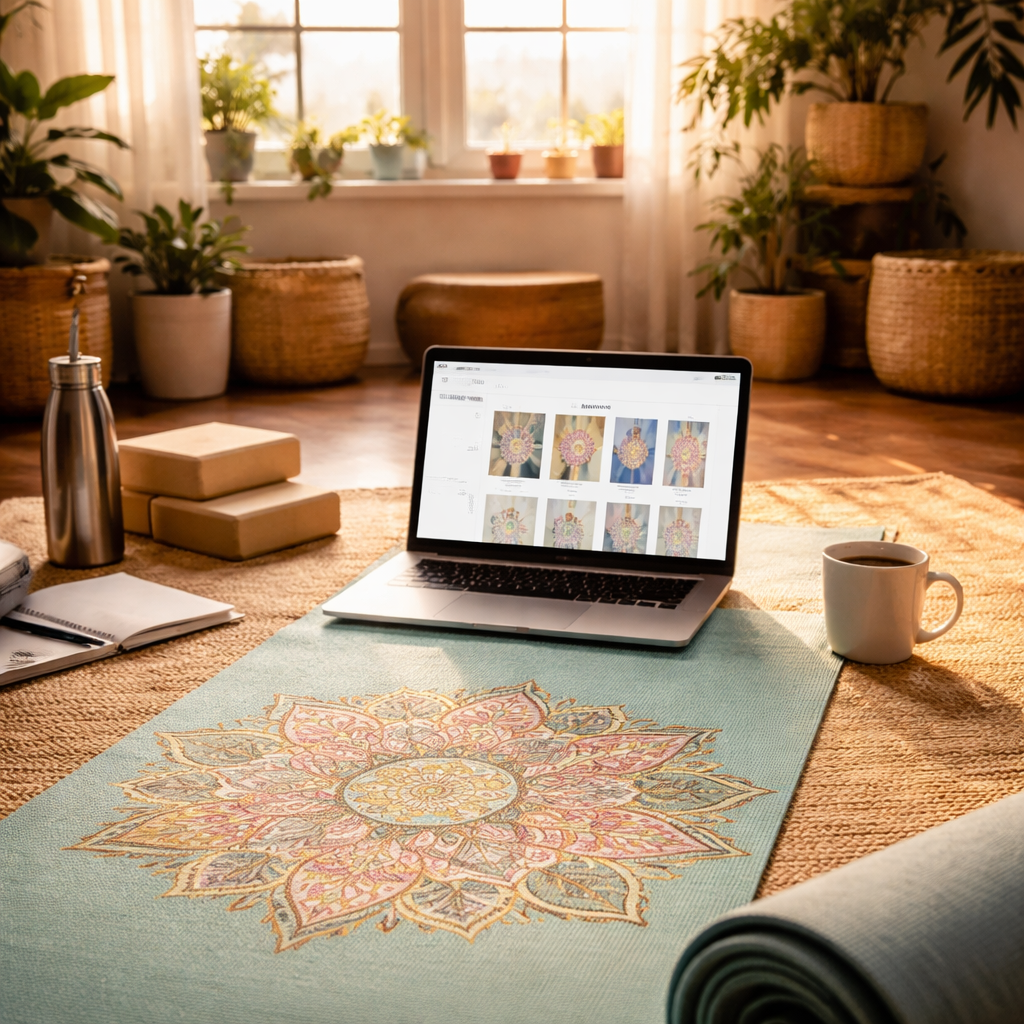
By following these steps, you’ll move from a single sample mat to a growing online brand.
Conclusion
Building a custom yoga mat print on demand business is within reach for anyone who loves yoga and wants to earn online. You start by zeroing in on a clear niche, then pick a supplier that prints high‑quality mats. Next, you design eye‑catching graphics, set up a store that syncs with your POD partner, and price your mats so you earn a solid margin. Finally, you launch with focused social posts, ads, and influencer collaborations, then scale by adding more products and selling on multiple platforms. The steps are simple, but the results can be big if you stay consistent and keep listening to your customers. Ready to roll out your own mats? Take the first step today and watch your brand grow.
FAQ
What is the biggest advantage of a custom yoga mat print on demand model?
The biggest advantage is you never have to hold inventory. You design a mat, list it, and when a customer orders, the POD partner prints and ships it. This cuts risk, saves storage space, and lets you test many designs without upfront costs.
How do I choose the right material for my custom yoga mat print on demand product?
Look at grip, durability, and eco‑impact. PVC is cheap but less green. TPE offers a good balance of grip and recyclability. Natural rubber gives top grip and is biodegradable, though it can be pricier. Test samples of each to see which feels best for your target audience.
Can I sell my custom yoga mat print on demand designs on multiple platforms?
Yes. Most POD services integrate with Etsy, Shopify, Amazon, and Wix. By linking your store to the POD provider, you can push the same product listings to each marketplace and manage orders from a single dashboard.
What marketing channels work best for a custom yoga mat print on demand brand?
Social media, especially Instagram and Pinterest, works well because you can show the visual appeal of your mats. Small ad budgets, email newsletters, and collaborations with yoga influencers also drive traffic and sales.
How do I set a price that covers costs and still attracts buyers?
Calculate the base cost (product + shipping), add platform fees, then apply a markup of 40‑60 %. Test the price with a limited‑time discount to see how demand reacts, and adjust as needed.
Is it worth ordering a sample before listing my custom yoga mat print on demand?
Absolutely. A sample lets you check color accuracy, material feel, and print durability. Spot‑checking a few mats saves you from bad reviews later and helps you fine‑tune the design.



Leave a comment
This site is protected by hCaptcha and the hCaptcha Privacy Policy and Terms of Service apply.